The Town Built on Coal, and the Tour That Takes You Into It
Longyearbyen exists because of a coal seam. The Gruve 3 mine tour has 491 reviews, more than every other Svalbard listing combined, and almost nobody books it first.
 By Lars Hansen, Norway tour specialist covering Arctic Norway and Svalbard
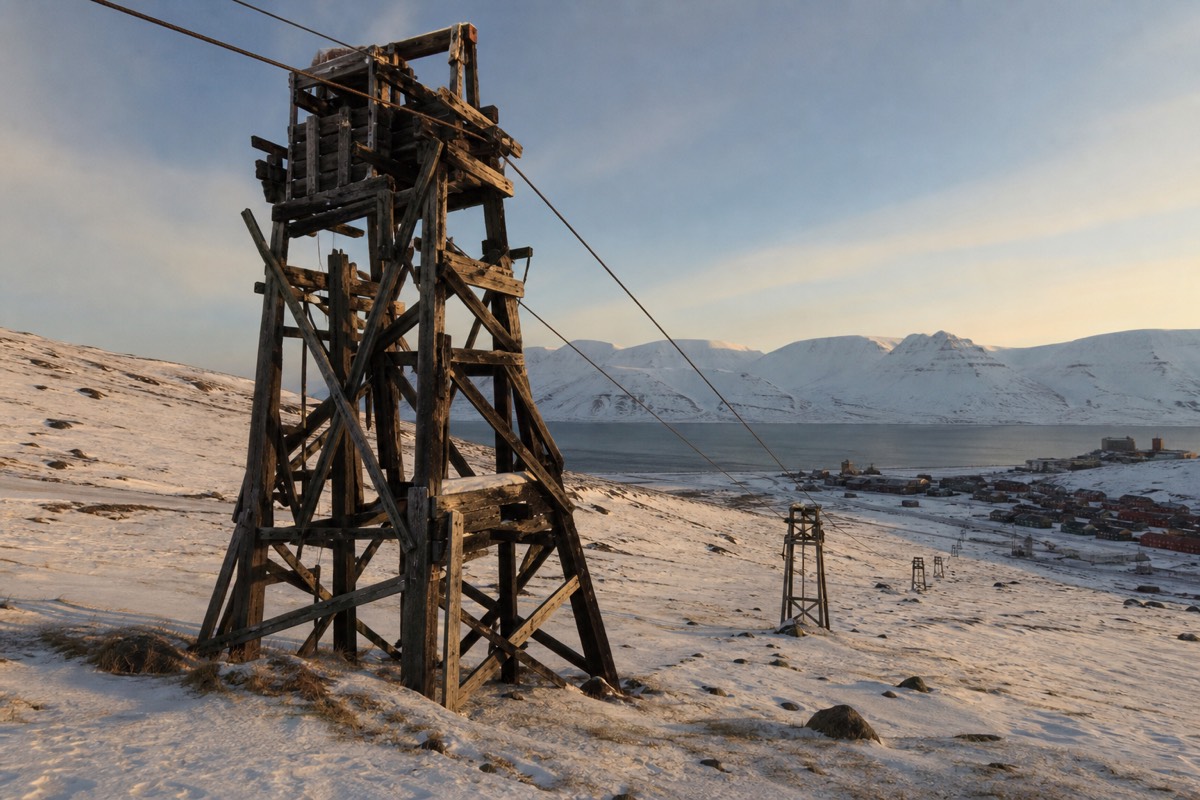
Look up from anywhere in Longyearbyen and you will see timber structures on the hillsides, connected by lines of cable, standing over nothing. They are the headframes and aerial ropeway towers of seven coal mines, and they are the reason there is a town here at all.
Nobody came to Svalbard for the scenery. They came for the seam.
The listing that wins by a factor of ten
Of the 62 bookable Svalbard tours, one has a review count in the hundreds. The next highest sits under fifty.
That is not a rounding difference, it is a different universe. The Gruve 3 historic coal mine tour, at 4.8 stars and about $146 for three hours, has more reviews than the other sixty listings on this site put together. And it is not the tour anyone comes to Svalbard planning to do.
| Listing | Reviews | Rating |
|---|---|---|
| Gruve 3 historic coal mine | 491 | 4.8 |
| Seed Vault and Arctic viewpoint by car | 49 | 4.5 |
| Pyramiden and glacier boat tour | 40 | 4.6 |
| Northern lights photography tour | 36 | 4.6 |
| Seed Vault and town icons | 34 | 4.8 |
| Everything else | Single digits to low twenties | Varies |
Part of that is volume: it runs all year, it is cheap, and cruise passengers ashore for a day can fit it. But a 4.8 across hundreds of reviews is not a volume artefact. People genuinely like it, and the reviews say why.
What the reviews actually say
Andrew, from the United Kingdom, in May 2026, typos and all: "The was a great success and well presented by the guide [...] Listening about her own personal experiences-some who as walked the walk-in the minning industry.To even begin to image this lifestyle and work,we have had a tad taste of it..my respect to those in this work.Also you get to see the entrance to the other storage vault."
Guides on this tour have often worked in the industry, and that is the difference. Graham Robert, from the United States, in July 2026: "Fantastic tour! A must do when visiting Longyearbyen. Anders was a fantastic driver and guide." Sarah, in May 2026: "This was a very interesting tour. Our guide Camille was not only informative but a great storyteller."
Nobody praises the mine. They praise the person explaining it, which tells you what kind of experience it is.
What the tour involves
You put on a boiler suit and a helmet with a lamp, and you walk into a disused mine on foot. It is not a museum with a mock-up. The passages are the passages, the height is the height, and the height is not generous.
| Detail | Reality |
|---|---|
| Duration | 3 hours |
| From-price | About $146 |
| What you wear | Supplied overalls, helmet, lamp. Take a warm layer underneath. |
| Underground | Yes, genuinely, on foot |
| Height of passages | Low in places. Not for serious claustrophobia. |
| Season | Year-round, all twelve months |
| Weather dependency | Almost none. It is inside a mountain. |
| Pickup | Included |
That weather line is the practical reason to book it. Svalbard cancels tours constantly, and this one does not, which makes it the sensible thing to hold in reserve for the day the fjord closes. You can check live availability and prices on GetYourGuide, and the rest of the year-round category is on the Longyearbyen tours page.
Why the coal mattered, and why it stopped
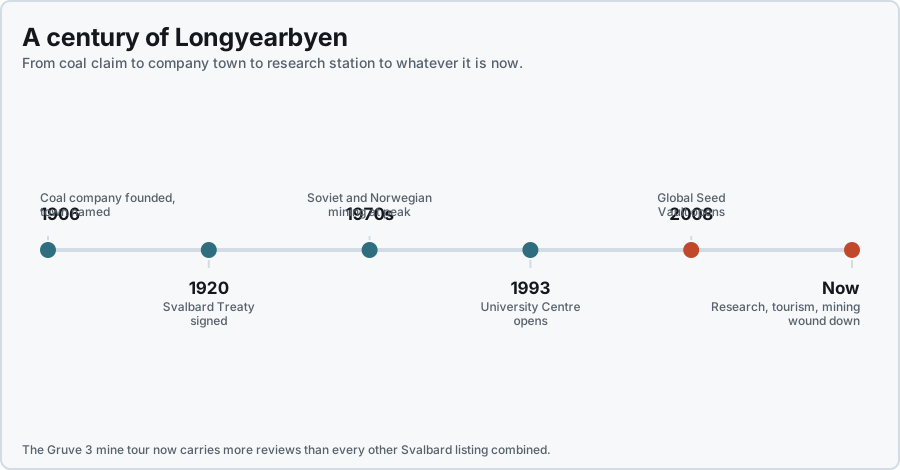
Coal was found here in quantity in the early twentieth century, and an American businessman named John Munro Longyear put a company town on the shore of Adventfjorden. The name stuck long after the company did not. Norwegian, Soviet and later Russian operations spread across Isfjorden, and for most of a century Svalbard's human population existed to dig.
Then economics, and then climate policy, and then the world moved. Longyearbyen's mining has wound down almost entirely. Barentsburg, the Russian settlement across the fjord, still mines. Pyramiden stopped in 1998 and the town emptied.
What replaced coal is research and tourism, which is why a settlement of 2,500 has a university, a seed vault, a data archive in a disused mine and 62 bookable tours. The visitor side of that shift shows up in Longyearbyen's overnight-stay figures.
| Era | What Longyearbyen was |
|---|---|
| Early 1900s | A coal claim and a company camp |
| Mid century | A working Norwegian mining town, with Soviet neighbours |
| 1998 | Pyramiden abandoned across the fjord |
| 2008 | The Global Seed Vault opens above the airport road |
| Now | Research, university, tourism, and a heavily regulated environment |
The habits coal left behind
Two survive, and both surprise visitors.
Shoes come off indoors. Everywhere: guesthouses, museums, some restaurants. It began because nobody wanted coal dust tracked into a home and it outlived the coal entirely. Pack socks you are content to be seen in.
The buildings sit on stilts. Permafrost would swallow a slab foundation, so structures stand on piles driven into frozen ground. It gives the whole town a temporary, expeditionary look that has now lasted a hundred years.
And a third thing, less a habit than a design decision: the houses are painted in strong reds, ochres and blues, chosen deliberately for the months when there is no daylight to give the place any colour of its own. Against snow and total darkness it works remarkably well, which is why Longyearbyen photographs better in polar night than in summer.
The other things you can do in town
The mine tour is the standout but the category is deeper than people assume, and it is the only one running every month of the year.
| Tour | Time | Real rating | From-price |
|---|---|---|---|
| Gruve 3 coal mine | 3 hours | 4.8 across 491 | $146 |
| Seed Vault by car | 2 hours | 4.5 across 49 | $128 |
| Seed Vault and town icons | 2 hours | 4.8 across 34 | $209 |
| Walking tour with a local | 2.5 hours | 4.7 across 17 | $112 |
| City bike tour | 2 hours | 4.7 across 9 | $194 |
The $112 walking tour is the cheapest bookable thing in Svalbard, rated 4.7 by its reviewers, and you can check the tour here. It stays inside the settlement, which means it needs no rifle and no exemption, unlike everything that leaves town. Why that matters is explained in do you need a guide.
If you are building an itinerary, the pattern that works is one weatherproof town booking held in reserve behind two outdoor ones. How many days you need sets out why, and things to do in Longyearbyen covers the free half-day around it.
Questions about the mine and the town
Is the Gruve 3 mine tour claustrophobic?
Parts of it are low, and you walk in on foot rather than being driven through a wide tunnel. It is not a crawl, but it is a real mine at real mine dimensions. If tight spaces are a genuine problem for you it is worth asking the operator about the specific route before booking. Most people find it fine and memorable rather than uncomfortable.
Why does the mine tour have so many more reviews than everything else?
Three reasons compounding: it runs all twelve months while most Svalbard tours run four or five, it is cheap at $146, and it fits a cruise passenger's few hours ashore. Volume alone would not produce 4.8 stars, though. The reviews consistently credit guides who worked in the industry, which is the actual product.
Are any coal mines still working in Svalbard?
Longyearbyen's mining has wound down almost entirely, which is why the headframes on the hillsides are monuments now. Barentsburg, the Russian settlement about 55 km west, still mines, and a boat trip there is one of the odder days available: a working Soviet-era mining town on a Norwegian archipelago you flew to from Oslo.
Plan your tour
The tour into the town's own reason
Initial editorial choice, not a personalized eligibility check. Confirm the operator’s full requirements before booking.
Go into the mine the town came from
This screens only the season, the time window and the pick you choose, using each listing’s published duration and season. Health, fitness, language, licence and every remaining requirement still need operator confirmation, and travel to the meeting point is not included in the durations.
- Gruve 3 historic coal mine tour: Three hours inside a real coal mine with guides who worked the industry, and the deepest review history in the whole Svalbard inventory. 3 hours Runs year-round but books out; helmets and lamps supplied.
- Global Seed Vault & Arctic viewpoint by car: The Global Seed Vault entrance and the Arctic viewpoint from a car tour, in two hours at the easiest effort. 2 hours You see the Vault's entrance from outside; entry itself is not part of any tour.
- Longyearbyen walking tour with a local guide: The town on foot with a local guide, two and a half hours covering the history that the buildings keep hiding. 2.5 hours Town walking, so it runs in every season; dress for standing still.
Gruve 3 historic coal mine tour
Have your travel date in mind? Check it before arranging the rest of your day. Three hours inside a real coal mine with guides who worked the industry, and the deepest review history in the whole Svalbard inventory.
3 hours
Runs year-round but books out; helmets and lamps supplied.
Check your date on GetYourGuide