The Svalbard Global Seed Vault: Can You Visit It?
The most photographed door in the Arctic, and the one nobody gets to open.
 Verified by Lars Hansen, Norway tour specialist covering Arctic Norway and Svalbard
Short answer
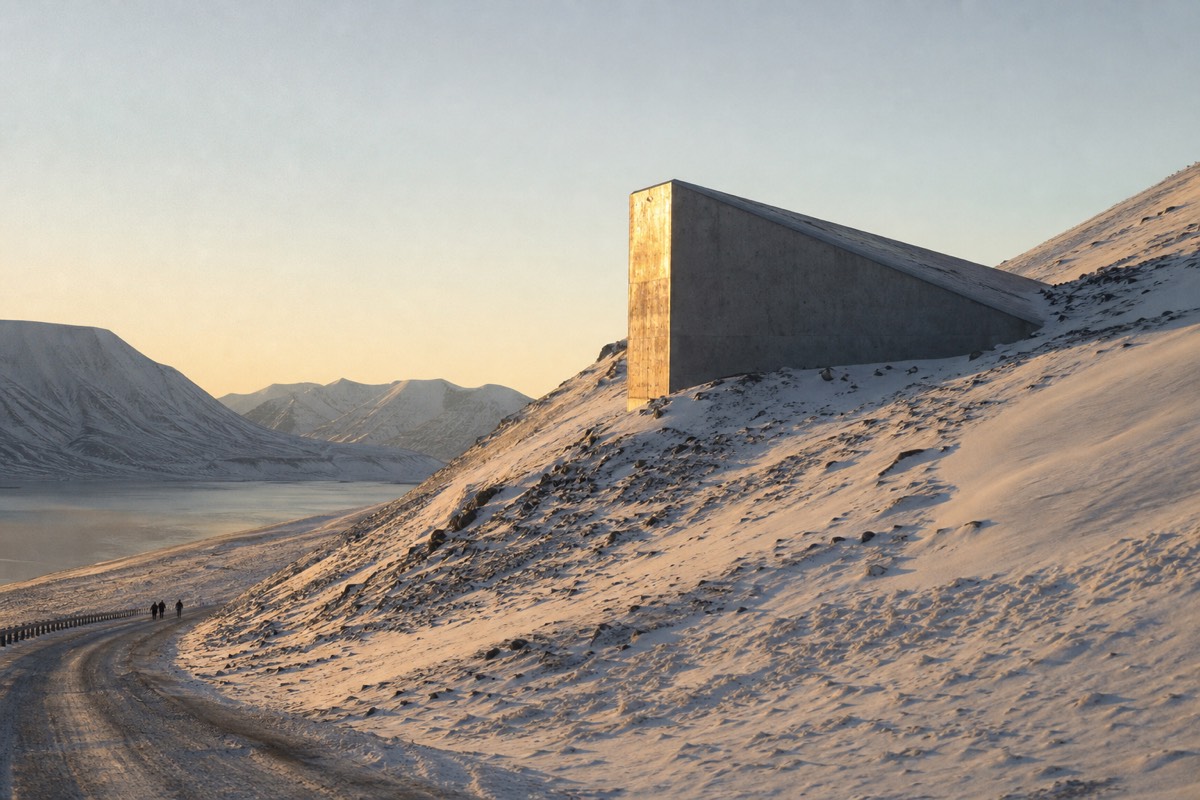
No. The Svalbard Global Seed Vault is a working, sealed seed bank and is permanently closed to the public. There is no tour, at any price, that goes inside. What you can do is stand at the exterior, which is a striking concrete wedge cut into a hillside above Longyearbyen with an illuminated artwork above the door, and several tours from $128 take you there and tell the story.
It sits above the airport road, a slab of concrete driven into a mountainside at an angle, with a strip of illuminated steel and mirrors running along its top edge. In polar night it glows. It is one of the most recognisable structures in the Arctic and it contains more than a million seed samples from almost every country on earth.
You are not going in. Nobody is.
Can you go inside the Svalbard Global Seed Vault?
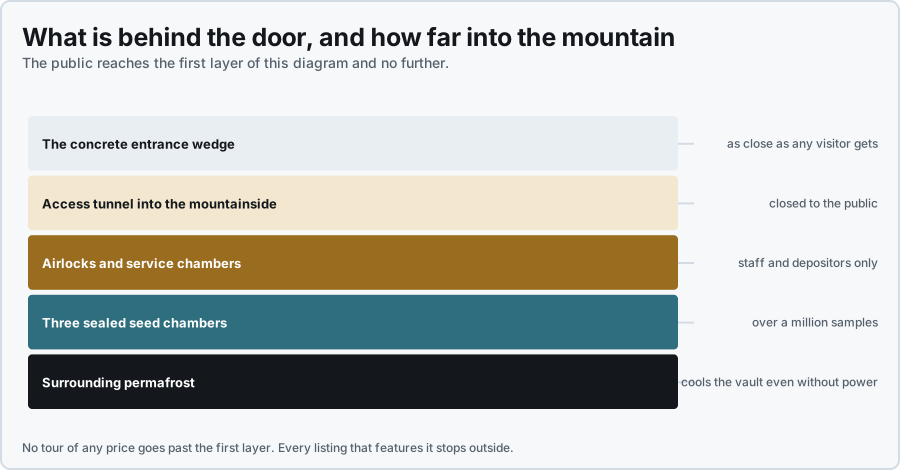
No. The vault is a working seed bank, sealed and climate-controlled, and it is permanently closed to the public. There is no tour of any kind or any price that goes inside. Access is limited to depositors and staff on the small number of occasions the vault is opened each year, and every tour that features it stops at the exterior.
This is the single most persistent misunderstanding about visiting Svalbard, and it is worth being blunt because a number of listings and articles are vague enough to let people hope. The Crop Trust, which co-manages it, and the official vault site both state the position plainly.
| What people expect | What is actually possible |
|---|---|
| A tour of the seed chambers | Not possible for anyone outside the operation |
| Going through the entrance tunnel | No |
| A visitor centre at the site | No |
| Seeing the exterior close up | Yes, and it is genuinely striking |
| Learning the full story on site | Yes, and this is what the tours deliver |
| Photographing it | Yes, and it photographs extremely well in the dark months |
Which tours take you to the Seed Vault?
Several Longyearbyen listings include it, from about $128 for a two-hour car tour that also covers Adventdalen and the old mining sites, up to $209 for the better-rated version that spends more time on the town's own story. There are also guided walks out to it, at around $184.
| Tour | Time | Real rating | From-price | What else it covers |
|---|---|---|---|---|
| Seed Vault and Arctic viewpoint by car | 2 hours | 4.5 across 49 reviews | $128 | Town, Adventdalen, mining sites |
| Seed Vault and Longyearbyen icons | 2 hours | 4.8 across 34 reviews | $209 | More of the town's history |
| Seed Vault guided walk | 3.5 hours | 4.6 across 8 reviews | $184 | On foot, with the valley approach |
| Seed Vault in-depth tour | 2 hours | On the listing | $202 | Focused on the vault itself |
| Midnight sun hike and Seed Vault | 3 hours | 4.7 across 11 reviews | $210 | Summer only, with a viewpoint climb |
If you would rather have the town's full story than the cheapest stop, the better-rated version runs at 4.8 from its reviewers for about $209, and you can check the tour here. The $128 car tour is the cheapest route and one reviewer, Michelle from the United States in August 2026, put it simply: "It was a great way to see the town and know it's history. The highlight was being at the Global Seed Vault." You can check live availability and prices on GetYourGuide, and the full category with real ratings is on the Longyearbyen tours page.
Why is the seed vault in Svalbard?
Permafrost, geological stability, remoteness and political neutrality. The mountain keeps the chambers cold even if the refrigeration fails, Svalbard has no meaningful seismic or volcanic activity, it is hard to reach, and the Svalbard Treaty gives it a legal status that suits an international facility.
The design logic is genuinely elegant. The vault sits deep enough inside the permafrost that the surrounding rock does most of the cooling work, so a total power failure would degrade conditions over decades rather than days. It is above any plausible sea-level rise. And it is a long way from the conflicts that destroy national gene banks, which is not a hypothetical: the vault has already made a withdrawal, to restore collections lost from a gene bank in Aleppo during the Syrian war.
| Design factor | Why Svalbard |
|---|---|
| Natural cooling | Permafrost keeps the chambers cold without power |
| Geological stability | No significant earthquake or volcanic risk |
| Elevation | Well above any projected sea-level rise |
| Remoteness | Hard to reach accidentally or deliberately |
| Legal status | The Svalbard Treaty gives it an unusual international footing |
| Existing infrastructure | An airport and a settlement already there, so it is reachable when needed |
Is it worth going to see if you cannot go in?
Yes, with the right expectation. It is a genuinely arresting piece of architecture in a landscape with nothing else in it, and the artwork above the entrance is designed to catch what light there is. In polar night, when it glows against total darkness, it is one of the best photographs in Svalbard.
What makes the tours worth booking rather than walking up yourself is the story. The vault is interesting for what it represents rather than what you can see, and a guide with the Aleppo withdrawal, the treaty history and the permafrost engineering makes twenty minutes at a concrete door into something. Without that, it is a concrete door.
You can also see it from the road below without a tour, which costs nothing. The guided version adds the explanation and, on the car tours, the rest of Adventdalen and the mining sites.
What to expect when you get there
A short stop, a photograph, and a talk. You will be outside for fifteen to thirty minutes at a spot with no shelter, which in January means dressing for standing still rather than walking. The approach road is gritted and the tours drive it, so this is one of the least physically demanding things in Svalbard.
The vault is technically just outside the settlement boundary but road-accessible, which is why the car tours can run it without the full outdoor apparatus that a hike needs. That also makes it one of the few things that stays available when the weather closes everything else down, alongside the Gruve 3 coal mine tour, which is underground.
If the vault is the reason you are coming to Svalbard, be honest with yourself about what a twenty-minute stop at an exterior is worth, and read is Svalbard worth visiting before booking a flight around it.
Common questions about the Seed Vault
Has the seed vault ever been used?
Yes. Its best-known withdrawal restored collections lost from a gene bank in Aleppo during the Syrian war, and duplicates were later returned to the vault once the material had been regrown elsewhere. That is exactly the scenario it was built for: not a doomsday event, but the ordinary destruction of a national gene bank.
Is the seed vault safe from climate change?
It has had one widely reported incident, when meltwater entered the entrance tunnel and froze, without reaching the seed chambers. Substantial waterproofing and drainage work followed. The chambers themselves sit deep inside permafrost well above sea level, and the design assumes the refrigeration might fail rather than that it never will.
How many seeds are in the vault?
More than a million distinct seed samples, deposited by gene banks from almost every country, with capacity for several times that. Each sample is a variety rather than a single seed, so the collection represents an enormous share of the world's crop diversity. Depositors retain ownership; the vault is a safety deposit box, not a library.
Can I see the seed vault without a tour?
Yes, from the road below it, which is inside the area you can reach without a guide and costs nothing. What you cannot do is approach the entrance itself. If you just want the photograph, walking or being driven to the viewpoint is enough. If you want to understand what you are looking at, the guided versions on the Longyearbyen tours page are worth the money.
Are there other vaults in Svalbard?
Yes, the Arctic World Archive, in a nearby disused mine, which stores digital data on film rather than seeds. It is likewise not open to the public. Some Longyearbyen tours point out its entrance while explaining the vault, which is how most visitors learn it exists at all.
Plan your tour
See the vault the only way anyone can
Initial editorial choice, not a personalized eligibility check. Confirm the operator’s full requirements before booking.
Choose how you see the vault
This screens only the season, the time window and the pick you choose, using each listing’s published duration and season. Health, fitness, language, licence and every remaining requirement still need operator confirmation, and travel to the meeting point is not included in the durations.
- Global Seed Vault & Arctic viewpoint by car: The Global Seed Vault entrance and the Arctic viewpoint from a car tour, in two hours at the easiest effort. 2 hours You see the Vault's entrance from outside; entry itself is not part of any tour.
- Global Seed Vault and Longyearbyen icons: The Seed Vault plus the town's icons in one two-hour loop, the highest-rated of the vault tours. 2 hours Two hours and photo stops; the Vault exterior only.
- Midnight sun hike & Global Seed Vault: A three-hour evening hike to the Seed Vault under the midnight sun, the highest-rated of the summer night walks. 3 hours Midnight-sun season only, roughly late April to August.
Global Seed Vault & Arctic viewpoint by car
Have your travel date in mind? Check it before arranging the rest of your day. The Global Seed Vault entrance and the Arctic viewpoint from a car tour, in two hours at the easiest effort.
2 hours
You see the Vault's entrance from outside; entry itself is not part of any tour.
Listings loaded by GetYourGuide. If they do not load, browse Svalbard listings on GetYourGuide.Check your date on GetYourGuide